From Experiment to Economic Engine: How New Town Transformed Orchard Farm
By Brett O’Daniell
When New Town at St. Charles was first proposed in the early 2000s, it was widely viewed as an experiment. A walkable, mixed-use community built on former farmland sat far outside the region’s development norms, and skepticism was common among local leaders and residents alike. Orchard Farm School District itself remained largely rural, lightly populated and peripheral to the St. Louis housing conversation.
Nearly two decades later, the data tells a very different story.
Market Performance Defies Expectations
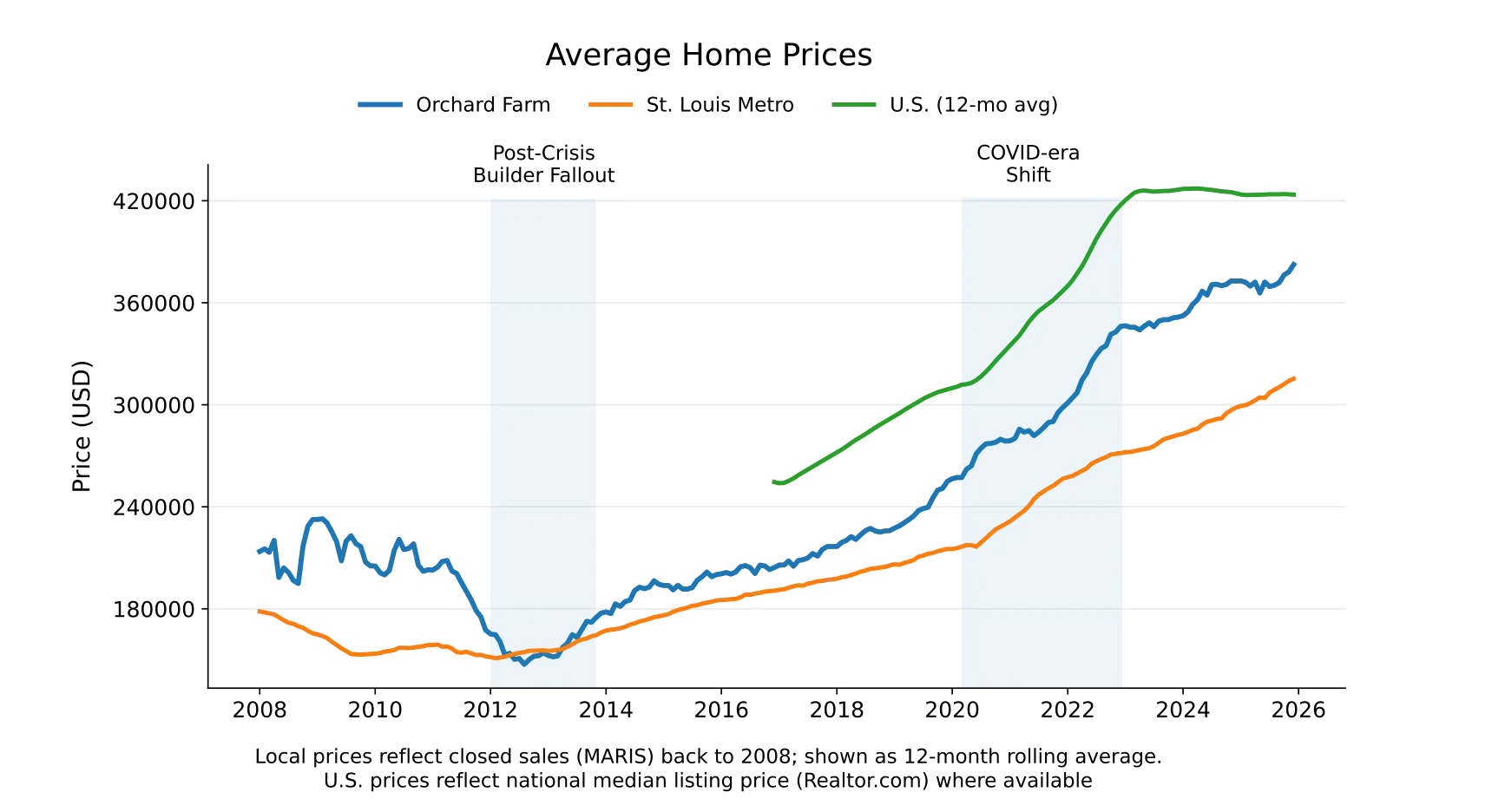
Historical MLS figures show that since 2008, Orchard Farm has consistently carried higher home prices than the broader St. Louis region, signaling that demand took hold earlier and more durably than many expected. The lone exception emerged during the 2012–2014 Post-Crisis Builder Fallout, when Orchard Farm’s sales prices tightened closely with the regional average. That period aligned with the lagged effects of the Great Recession, when builder bankruptcies surged nationally, land debt constrained development and housing markets across the country reset.
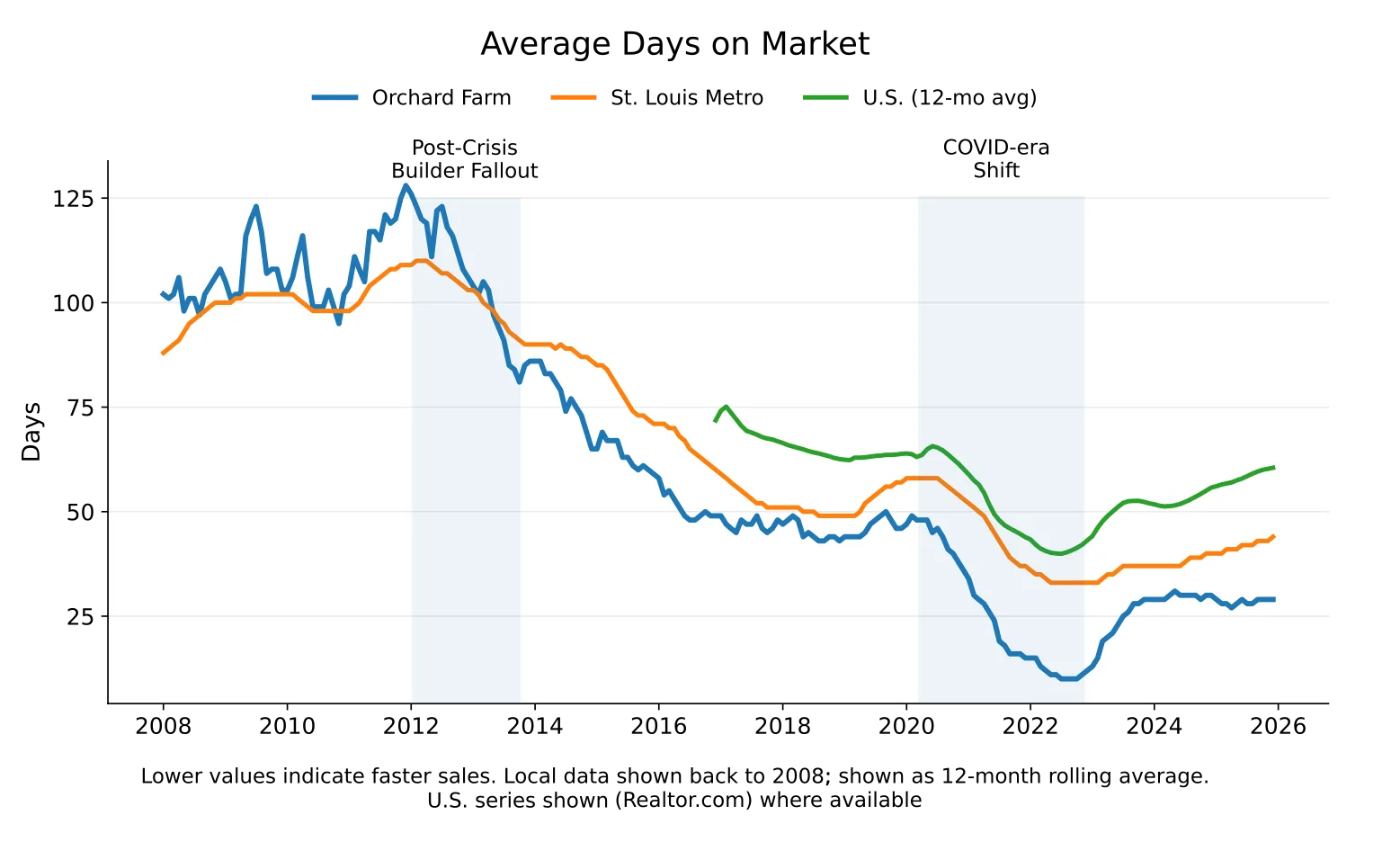
What’s notable is not that Orchard Farm tightened with the region — it’s that it didn’t fall behind it. As the housing market stabilized, Orchard Farm re-established its pricing premium and held it. Average sales prices resumed a steady climb, and just as important, homes began selling faster than the metro average beginning in 2013. That relationship has persisted for more than a decade. Even as prices rose, days on market declined, signaling that higher valuations were being met with sustained buyer demand rather than hesitation.
Resilience Through Market Shifts
The contrast became especially clear during the 2020–2022 COVID-era Shift and its immediate aftermath. From 2020 through 2023, Orchard Farm experienced a sharper increase in home prices alongside a pronounced drop in days on market compared with the broader region. While low interest rates and constrained supply lifted most housing markets, Orchard Farm consistently cleared homes more quickly — evidence of a location that benefitted disproportionately from changing buyer preferences.
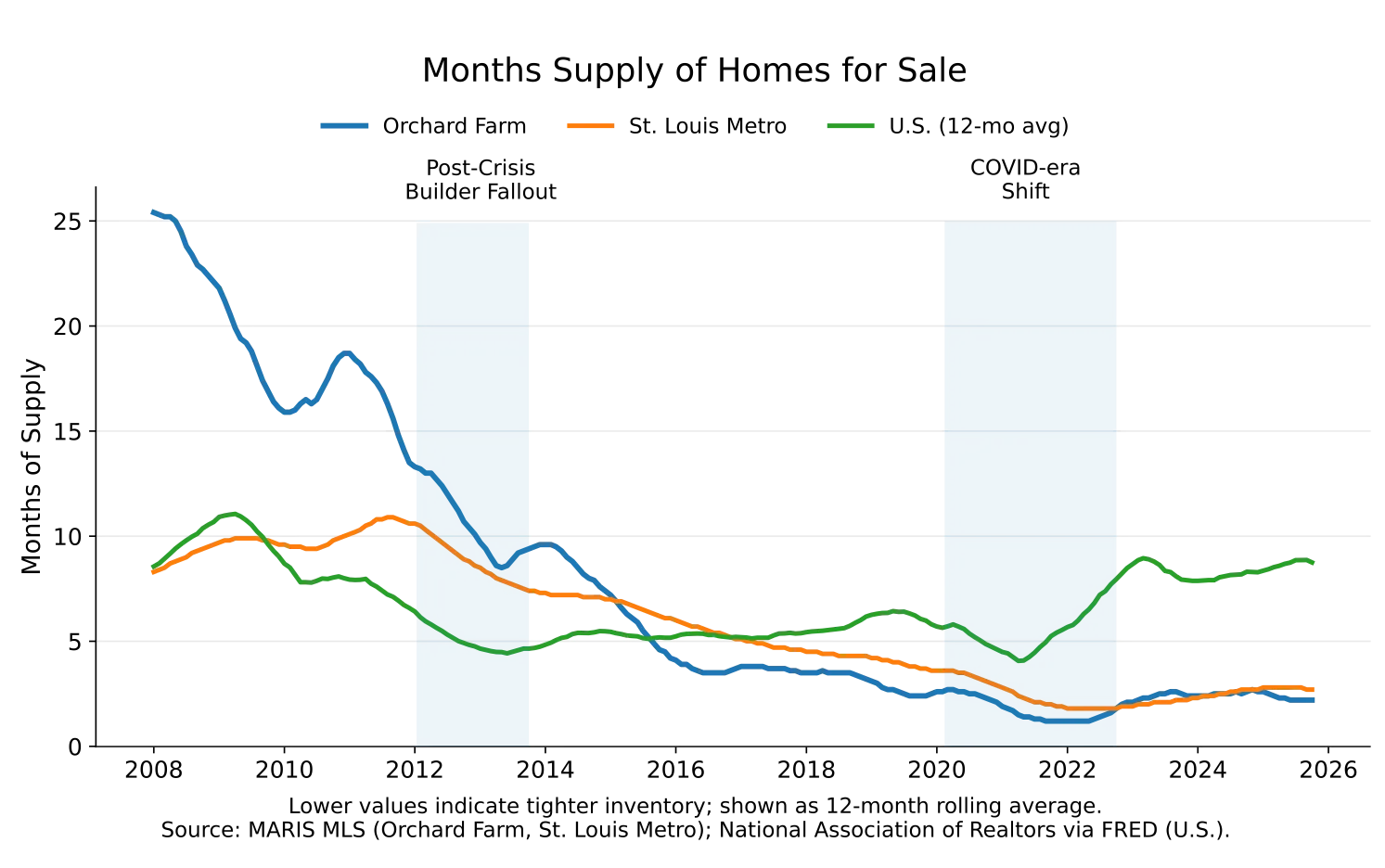
Months supply of homes tells another important part of the story. In the years before New Town, Orchard Farm carried significantly more inventory than the region and the nation, reflecting its rural character and limited buyer pool. Over time, that excess supply was absorbed. By the mid-2010s, months supply converged with — and often fell below — regional and national norms. Today, Orchard Farm operates as a balanced, supply-disciplined market, a fundamental shift from its earlier profile.
More Than a Development: A Community Evolution
Taken together, these trends point to something deeper than a single development’s success. They reflect a broader shift in how and where people choose to live. Walkability, mixed-use spaces and a sense of community — once viewed locally as impractical or even naive — have proven to be durable drivers of demand. New Town didn’t simply add homes; it helped Orchard Farm evolve from a rural edge market into one of the region’s most consistently competitive residential environments.
That evolution has fueled population growth, business activity and enrollment, making Orchard Farm the fastest-growing public school district in the St. Louis region. For investors, business owners and residents alike, the lesson is a humble but powerful one: over the long run, people vote with their feet — and the market tends to reward places built with intention.