By: Brett O’Daniell
The four women who own the businesses that operate in the kiosks surrounding New Town’s amphitheater have remarkably different stories.
Today, they serve quesadillas, sno-cones, kolaches, candy and ice cream to thousands of residents and visitors each year. Spend enough time listening to them, however, and the conversation quickly moves beyond menus. Their stories become ones of faith, perseverance, opportunity, family and the relationships that have quietly grown alongside their businesses.
The kiosks come alive whenever New Town gathers. Children study the flavor choices, families eat dinner at picnic tables around the amphitheater, and concertgoers cool off with something sweet during a break in the music. The buildings may be small, but the businesses inside them have become a major part of the town center.
Each of these women arrived by a different road. Shonte Harmon-Young took a leap after retiring from county government. Molly Schad built a business and developed a practical understanding of how the kiosks can launch new entrepreneurs. Idella Johnson has served generations of families from the same window since 2007. Jessica Mugridge entered through culinary school, then unexpectedly became the owner of the business where she had completed her externship.
Together, their stories offer four chapters in the life of New Town’s amphitheater kiosks.
Faith to Begin
Ask Shonte Harmon-Young how she came to operate two amphitheater kiosks—Queso Whaat and The Kandi Lady—and one word continues to surface: blessings.
She is grateful for the blessings she has received, the people she has met and the customers who choose to support her businesses.
Shonte had operated a catering business for years while working in county government. When she moved from a civil-service position into an appointed role, she began planning what would come next. Her family encouraged her to focus on quesadillas, but she wanted room to explore different flavors. The diversity has paid off, and she is now working toward franchising Queso Whaat.
The Kandi Lady grew from a different kind of inspiration. Shonte recalled the neighborhood candy ladies and candy men of her childhood, who sold penny candy, pickles and small toys from the back of a station wagon. “We used to call them the candy lady or the candy man,” she said.
She wanted to recreate that feeling for New Town, mixing old-school favorites like Mary Janes, Bit-O-Honey and Slow Pokes with newer candy, desserts and affordable toys. “I just thought that I wanted to continue that cool concept,” she said.
Yet when asked about her greatest joy, she did not mention expansion. “Meeting people,” she said. “I’ve been very blessed to have met some amazing people.”
Those relationships have led to weddings, graduations, birthdays and a 400-person Juneteenth event. More than the size of the jobs, though, she values the kindness of the people she has met, the children who return and the other kiosk owners, whom she called “so sweet and so awesome.”
She is equally clear about hospitality. Customers are choosing where to spend their money, and she does not take that lightly. “It is a blessing for me to have people say, ‘I want to spend my money with Queso Whaat, or Shonte, or The Kandi Lady,’” she said.
Faith is central to how Shonte understands her journey.
“Do it scared,” she said. “You have to do it afraid, and God is going to provide that path for you.” Trust does not remove the uncertainty. It gives her a reason to keep moving.
Creating Opportunity
Molly Schad’s journey into the kiosks began before she ever opened a window at the amphitheater. She and her family launched their sno-cone business near New Town Boulevard around 2010, later adding homemade chili and soups to help carry the business through colder months. After several years and time on a waiting list, Molly O’s moved into one of the amphitheater kiosks.
The business continued to evolve. When catering work disappeared during the pandemic, sno-cone sales grew as residents spent more time outdoors. As food costs later increased, Molly adjusted again, eventually developing Molly O’s Tropical Sno and Sno Tinis. Her story demonstrates one of the central lessons of kiosk ownership: a small space does not necessarily require a small imagination.
Molly also sees the kiosks as more than places to sell food and drinks. They can serve as business incubators—a manageable place to test a concept, establish a customer base and learn the demands of ownership before moving into a larger storefront. Marsala’s Market, BobaQue and The Bridge Coffee House all began in kiosks before growing into permanent locations, offering visible examples of what can happen when a small beginning meets consistent work.
“That’s kind of the original concept,” Molly explained. “You start at a kiosk, you build up enough so that you can get a storefront.” Each kiosk has different equipment and capabilities, so prospective owners must match their business plans to the available space and submit those plans through the New Town General Assembly’s approval process.
The location offers an advantage few start-up businesses receive: concerts, markets, festivals and community events taking place directly outside the window. Still, Molly is quick to point out that opportunity must be met with preparation. Owners need consistent hours, proper staffing and enough awareness of the community calendar to be open when people gather.
Her customer-service philosophy is similarly practical. When a long line forms, she teaches her employees not to greet the next person with an automatic apology. “Thank you for waiting,” she tells them to say. The difference is small but meaningful: the customer is acknowledged, while the employee’s hard work is not treated as a failure.
For Molly, creating opportunity also means understanding that one busy kiosk can benefit another. A concert crowd may arrive intending to buy one item and then discover several neighboring businesses. Each open window adds another reason for families to stay, explore and make the amphitheater a destination rather than simply a place to pass through.
Faith to Continue
If Shonte’s story is about faith to begin, Idella Johnson’s is about faith to continue.
Bonnidell’s opened on July 4, 2007, after Idella visited New Town for a concert and repeatedly heard people wondering where they could find ice cream. She had never owned an ice-cream shop, but the empty kiosk caught her attention. With experience in convenience stores, fast food and management—and a belief that everybody wants ice cream—she decided she could do it.
The first day did not inspire confidence. Their final inspection came July 3, the delivery followed, and they opened the next morning to a full day of concerts. “It was a mess,” Idella recalled. “I’m honestly surprised anybody came back. We were so bad.” They learned, adjusted and stayed, even through the difficult years surrounding the housing crisis when Idella admits she was sometimes simply too stubborn to quit.
Years later, another difficult season brought her closer to closing. The cost of making her ice cream had risen so much that continuing no longer seemed practical. Idella prayed about the decision, wondering whether the time had come to let the business go.
While walking her daughter’s dog, Idella followed as it wandered toward a picnic table. Written on the table was a word she couldn’t ignore: OPEN. Idella received it as an answer to her prayer. Not long afterward, a Cedar Crest Ice Cream representative sought her out while she was working her second job to make ends meet at the Cornerstone Cafe, now Casa Mia. That was the beginning of a relationship that helped lower costs and gave Bonnidell’s a sustainable way forward.
Nearly two decades of business have now given Idella an abundance of stories. She has watched children grow up and return with children of their own. During the uncertainty of 2020, residents urged her to reopen because Bonnidell’s felt like part of their normal lives. Idella was surprised to hear the shop described as a destination; in her mind, she was simply opening the window and serving the people who had supported her from the beginning.
“I love the people,” she said. “Especially the kids.”
One little girl shaped a policy that remains in place today. On opening day, the child asked for sprinkles, but Bonnidell’s did not have any. When she cried, Idella nearly cried with her. Sprinkles appeared the next day, and they have been free ever since so a parent never has to refuse them because of an extra charge.
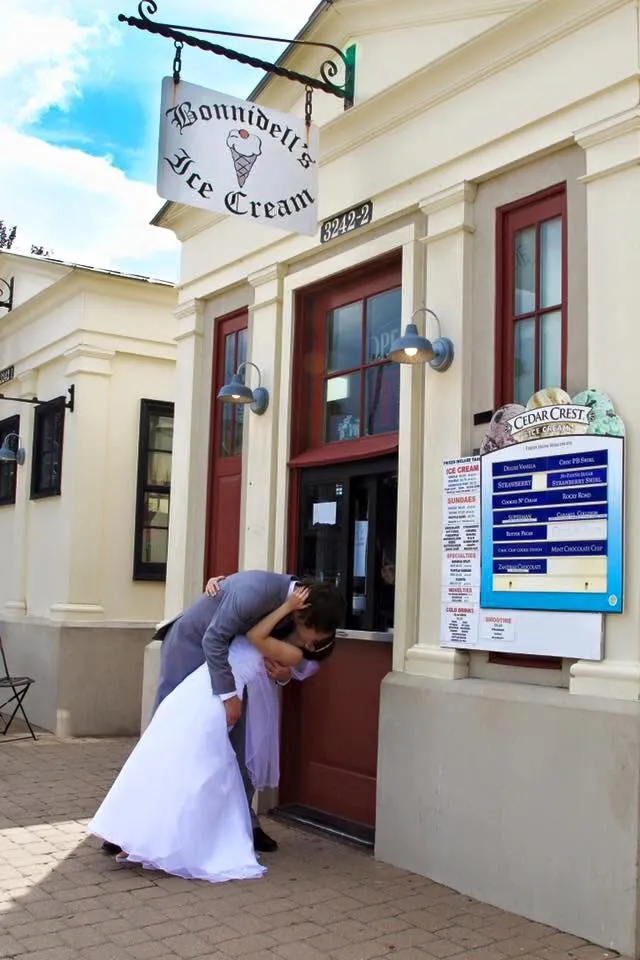
The kiosk has also become part of family milestones. Idella once helped a couple privately reveal their baby’s gender by placing the correct color of ice cream inside their cones. Her own daughter Jessica met her future husband, Greg, when they worked together at Bonnidell’s. Years later, they returned on their wedding day to get a picture in front of the little window where their relationship began. (see photo)
Idella’s goal remains as uncomplicated as it was sincere. “I just want them to leave happy. You can’t come to ice cream and be sad,” she said. “People come to ice cream to be happy.”
Last, But Certainly Not Least
Jessica Mugridge is the newest owner among the four, but her path to the kiosks began with the most formal preparation for the kitchen. Kurt’s Kolaches also is the only business that operates from two connected kiosks—one as a kitchen and the other for serving customers.
Jessica attended Auguste Escoffier School of Culinary Arts, studying baking and pastry, and completed her externship at Kurt’s Kolaches in 2025. When Kurt decided to sell, Jessica was presented with an opportunity she had not necessarily expected so soon. She chose to take it.
Jessica is raising three children, and ownership offered her something they could watch grow. “I wanted to build something that my kids could watch and be inspired by, and take over and get into,” she explained. “I love food, and I love to feed people and make people smile.” Her oldest child is already talking about starting a business of her own.
Formal training did not eliminate the surprises of ownership. Almost immediately, Jessica faced equipment problems involving refrigeration, water, electrical outlets and other repairs. She has changed recipes, experimented with new items, adjusted hours, and learned that weather can dramatically change a day at the amphitheater.
She also speaks honestly about anxiety. Jessica can be her own harshest critic and is sometimes surprised when customers praise her food. Yet she continues to seek feedback, refine recipes and find new ways to make a kolache stop feel like a complete meal rather than a single purchase.
What matters most is the customer’s reaction. “As long as I know you’re walking away and your expectations are met,” she said. “You feel like your dollar has been well spent.” She does not want anyone leaving with the feeling that trying something new was a mistake.
Her advice to another would-be entrepreneur is more powerful because she is still living through the uncertainty herself. “Don’t be scared,” Jessica said. “Don’t hold yourself back. Go all in.”
More Than Neighbors
The four women operate separate businesses, but they are not alone. Behind the scenes, they share a running text thread to pass information, celebrate strong days and encourage through the difficult ones. They offer different products, but their success is tied to the same weather, the same calendar and same families walking from window to window.
The next time you circle the amphitheater deciding what to eat, take a moment to look beyond the menu. Behind those six little windows are stories of courage, faith, hard work, family and friendship—and four women helping make New Town feel like home.
That is something you will never find on a menu.
Photo Note: A candid photo of the four talking could work especially well across the center spread or near Jessica’s section, with a caption such as:
What began as a photo shoot became a moment of connection. After discovering Jessica had been missing their group messages, the women gathered around her, asked how she was doing and began talking through ways they could help.